Edith Pilchester
The Darling Buds of MayEdith Pilchester’s life is organized around a verdict: almost everything is “absolutely ghastly.” Yet the refrain is not simply a complaint. It gives voice to the losses and constraints of a woman living alone in a changing rural economy, while her relentless committee work turns discontent into action. As secretary of the Pony Gymkhana Committee, an unexpected romantic partner for Pop Larkin, and the harried organizer of the event itself, Edith is at once an anxious guardian of order and one of the story’s most vivid sources of disorder.
Identity and Circumstances
Edith lives alone and keeps a number of laying hens. She can scarcely afford the expenses of running a car, while a horse is just within reach but a groom is not. She remembers a different household before the war: a little maid, a man in the garden, and a groom who also drove, cooked, brought early tea, and served hot whisky at night. That former arrangement has disappeared, and even the whisky has become difficult to afford. Her catalogue of loss makes the phrase “absolutely ghastly” a shorthand for diminished means as well as loneliness. The countryside around her has changed in ways that sharpen that sense of displacement. Workers go into strawberry, cherry, plum, apple, bean, and hop picking, or to the town’s canning factories, earning more than Edith can pay. The labor market that supports the rural harvest economy has made household help unaffordable to her. Her complaints therefore register a concrete social contrast: the people she needs are available for seasonal work, but not at the prices she can offer. The narration describes Edith as a fortyish, slightly moustached brunette, with a figure likened to a bolster. The comic physical portrait belongs to the story’s broad, teasing style, but it does not reduce her to a single trait. She is solitary and financially pressed, yet also vigorous, enterprising, and capable of surprise. The gulf between her lamenting language and her capacity for action is central to her characterization.
Committees, Causes, and the Gymkhana
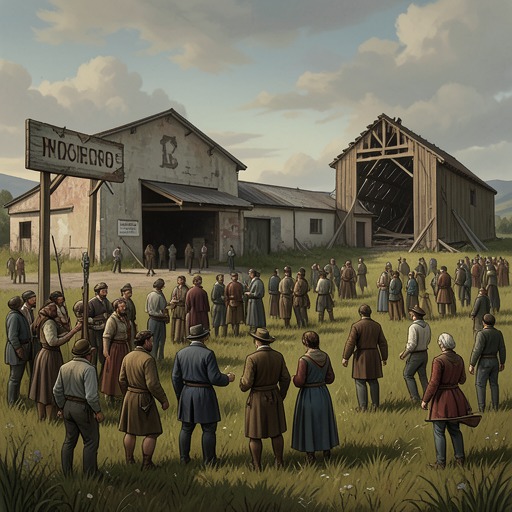
Edith responds to what she sees as the world’s accumulating wrongs by throwing herself into projects with near-ferocious energy. She prowls from committee to charity to bazaar, trying to put matters right; the narration likens her to a restless, thirsty lioness seeking prey. The image turns her anxious activism into a comic kind of pursuit. She is not merely present in local public life: she makes herself its tireless agent. That role brings her into the organization of the Pony Gymkhana. Edith is its secretary, and the Brigadier tells Pop Larkin that she will probably come to ask him to support the event. Pop calls her a sport, while Ma Larkin warns him not to assume that Edith’s affection is harmless. Their exchange foreshadows the personal entanglement that grows alongside the committee business, and shows how readily the Larkins treat formal public arrangements as an extension of their lively domestic world. On the day of the gymkhana, Edith’s organizing ambition collides spectacularly with the practical demands of the event. She arrives almost half past ten, four hours late, in a taxi she has hired in desperation. She carries a shooting stick, rolled mackintosh, spare cardigan, lunch, red vacuum flask, judging lists, a copy of The Times, several books, and a basket of pot-eggs. The eggs roll around her as she collapses in the field, turning the arrival of the committee’s great organizer into an image of overburdened, almost absurd preparedness. Pop and the Brigadier are so stunned that neither immediately goes to help her. Five minutes later, Edith is already rushing between tents at what the Brigadier calls a half-canter. She asks whether the caterers have arrived, searches for the loudspeaker, and frets about cancelled entries, insisting that they should have been cancelled by nine. The caterers have been on the field since seven and have already stopped for tea; the loudspeaker is present, but she trips over its wires. Her urgency is genuine, but it repeatedly meets facts already out of step with her schedule. The gap between her desire to control the day and the day’s unruly progress makes her both an effective force and a comic spectacle.
Edith and Pop Larkin
Edith’s relationship with Pop develops through teasing, practical encounters, and a decisive change in physical intimacy. In a cottage at twilight, after Edith has called him an “absolute lamb,” Pop suddenly wraps her in his arms and kisses her. The narration compares the kiss to a velvet battering ram and says that it affects Edith much as Pop’s cocktail affected Mr Charlton: with a disquieting heat that reveals sensations she had scarcely known. The scene is striking because it places a woman who has spent so much energy managing committees and other people’s problems in the position of being unexpectedly overwhelmed herself. The intimacy carries into the gymkhana day. Edith remembers Pop’s close attention to her knee in the Rolls-Royce and the kiss that, as Ma had predicted, made her sleep more sweetly. In the middle of the rushed event, she lets herself smile at Pop and tells him that he can be more than naughty. Her reference to their earlier encounter gives the smile its private meaning: beneath the public bustle and her habitual exasperation, a new, playful attachment has taken shape. Pop’s pursuit of that playfulness is apparent when he tries to persuade Edith to ride in the Ladies' Donkey Derby. She refuses, saying she honestly could not because it would be absolutely ghastly; when Pop reminds her that she likes fun, she recognizes that he is trying to be naughty. Her repeated phrase now serves a different purpose. It is still a protest, but it also participates in their flirtation, allowing her to resist Pop’s suggestion without withdrawing from their shared teasing.
The Donkey Derby and Its Aftermath
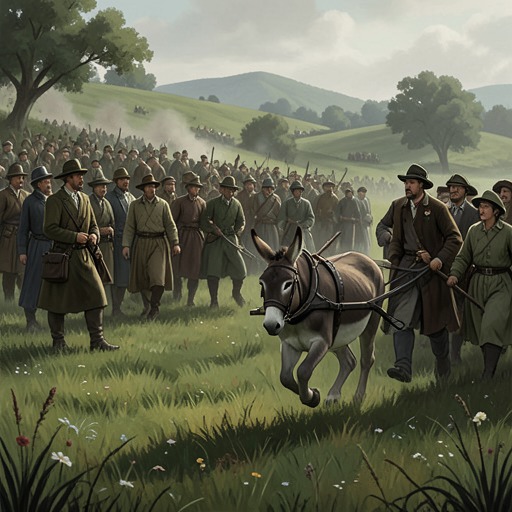
The Ladies' Donkey Derby is Pop’s late, inspired addition to the program. He persuades the committee that it owes him one in return for the use of the field, and supplies a silver cup he once bought at a sale. Its engraving belongs to an angling competition, a mismatch he considers unimportant. Edith, meanwhile, is behind the beer tent as Pop tries to coax her into the race, giving their private banter a place inside the public event she has labored to organize. The event turns from flirtatious persuasion to uncontrolled commotion when an announcement over the loudspeaker names a three-year-old, Anne Fitzgerald, who has lost her mother. The speaker gives a few sharp barks; Jasmine pricks up her ears and bolts through the final waving arcs of carrots, leaving Pop on the ground and scattering the crowd. Edith, who is riding, holds on with her knees as Pop had urged her to do. Within thirty seconds Jasmine is back at the river, staring at grasses, water-lilies, and irises, while Edith half-dismounts and half-falls in a disheveled, demoralized heap. Even in the mishap, Edith’s predicament is framed through the refrain she has applied to nearly everything else. The episode turns her fear of a humiliating outing into an actual, chaotic ride, but she does not simply abandon the saddle: she clings on through Jasmine’s flight. At the river she and the donkey encounter a soldier whose interrupted summer tryst prompts him to tell them to go away, mistaking Ma and her sister for the intruders. The confusion adds another layer to an ending already marked by public embarrassment and absurdity.
Narrative Role and Significance
Edith’s repeated “absolutely ghastly” is both her recognizable verbal signature and a measure of the gap between her expectations and her circumstances. Her solitary household, the cost of transport and help, and the changed availability of rural labor provide real grounds for frustration. But the phrase expands until it covers hens, loneliness, committees, and the smallest disruptions; its repetition makes distress comic without entirely cancelling it. Her energy supplies the counterpoint: she may deplore the state of things, but she repeatedly throws herself into trying to mend them. Her plot also depends on the contrast between control and surprise. Edith arrives at the gymkhana laden with lists and supplies, then meets a field where the caterers have finished tea, a loudspeaker’s wires lie underfoot, and a donkey can turn a race into a headlong flight. At the same time, her connection with Pop carries her beyond her familiar position as organizer and complainant. The woman who tries to set the world right is herself caught up in a romantic encounter and a public mishap that no schedule can manage. The story never replaces Edith’s habitual exasperation with a settled transformation. Instead, it gives the refrain new contexts: it begins as a description of her narrow, diminished circumstances, becomes a comic instrument of her tireless public activity, and finally accompanies flirtation and the Derby’s disorder. Her brief smile at Pop, amid the busiest day she has helped arrange, suggests not that the world has stopped being ghastly to her, but that its interruptions can also make room for pleasure.